What's in this paper
- How B2B buyers are using AI search
- Why most B2B tech companies are invisible in AI search
- What Answer Engine Optimization is — and isn't
- The five signals that get companies into the answer
- Where to start: a six-step AEO audit you can run in two hours
- The copy problem at the centre of AEO
The Invisible Problem
There is a shift in how B2B buyers find vendors, and most marketing teams haven't caught up yet.
It used to work like this: a VP of Operations needed a new procurement platform. She types “best procurement software for mid-market companies” into Google. She clicks through to five or six vendor sites over a few days, bookmarks a few, and eventually reaches out to two or three.
Now it works like this: she opens ChatGPT or Perplexity and types: “What are the best procurement platforms for a mid-market manufacturing company with 300 employees?” She gets a synthesized answer, a list of specific vendors with brief descriptions of what each one does well, in under ten seconds. She visits maybe two of them. The ones that weren’t mentioned don’t get a click.
This is the answer engine behavior. And it’s reshaping B2B discovery faster than most marketing teams realize.
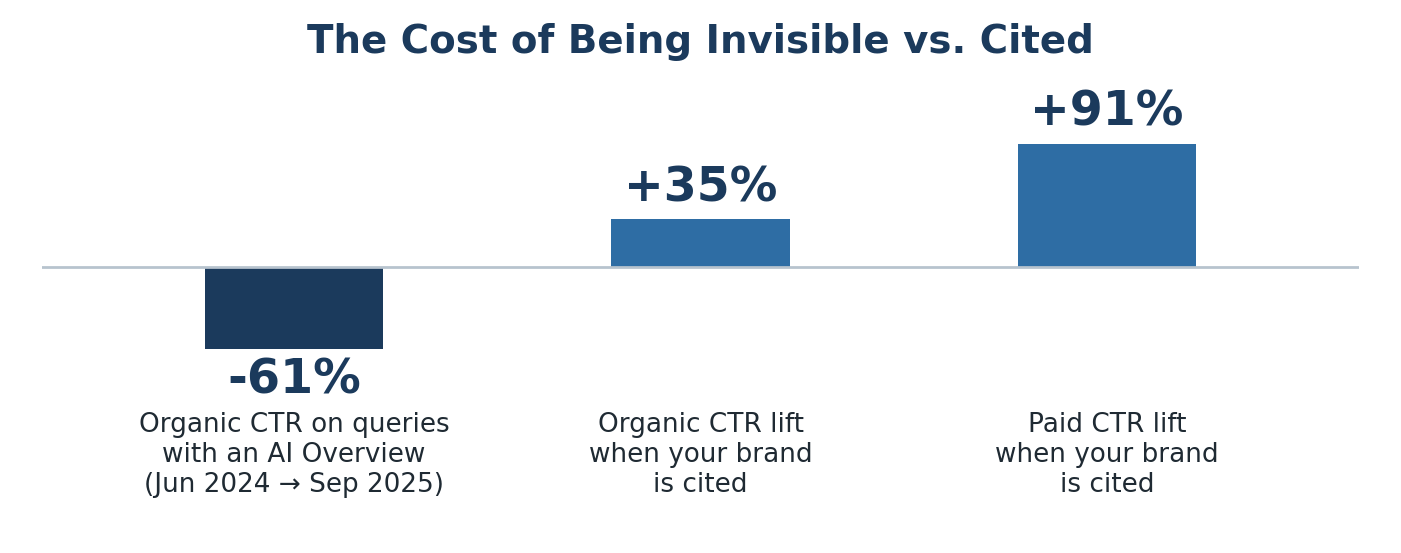
The companies that appear in those AI-generated answers are building awareness and securing shortlist placements before buyers ever reach their websites. The ones that don’t appear aren’t getting a second chance.
Answer Engine Optimization (AEO) is how you get the answer.
This guide explains what’s changing, why most B2B tech companies are invisible in AI search right now, and what to do about it.
By the Numbers
What the Data Shows
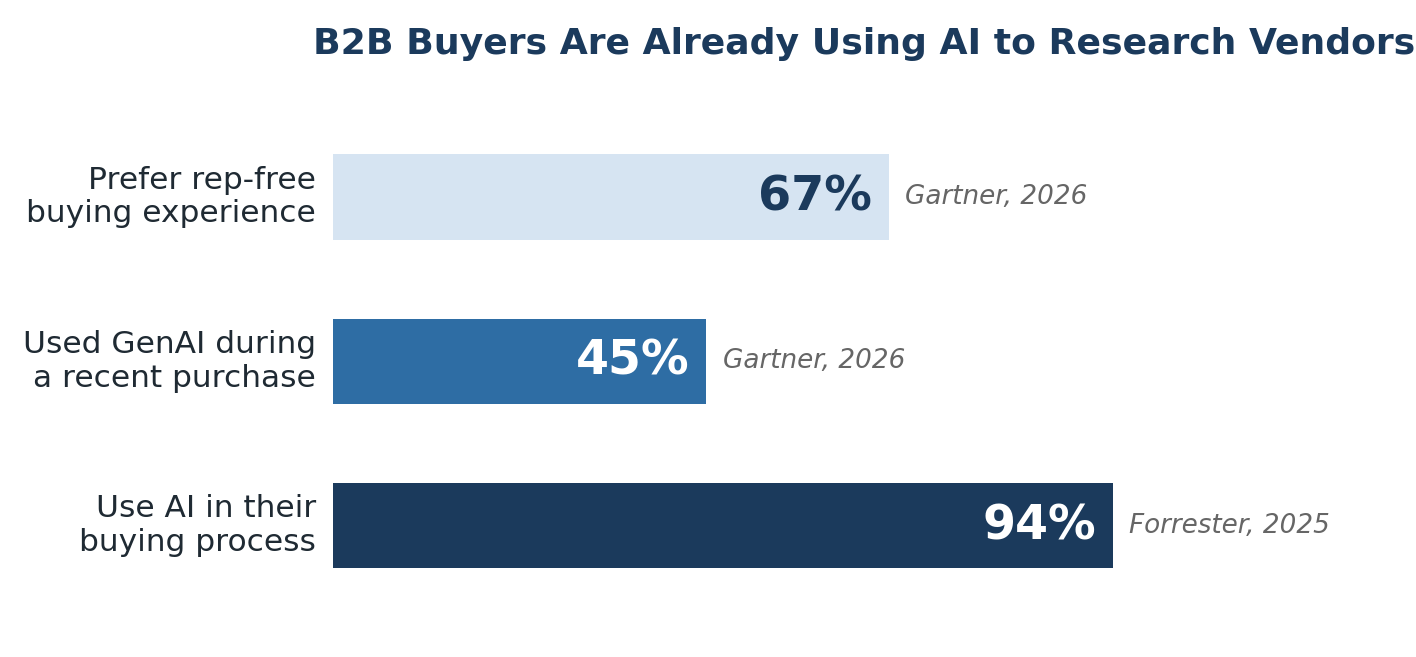
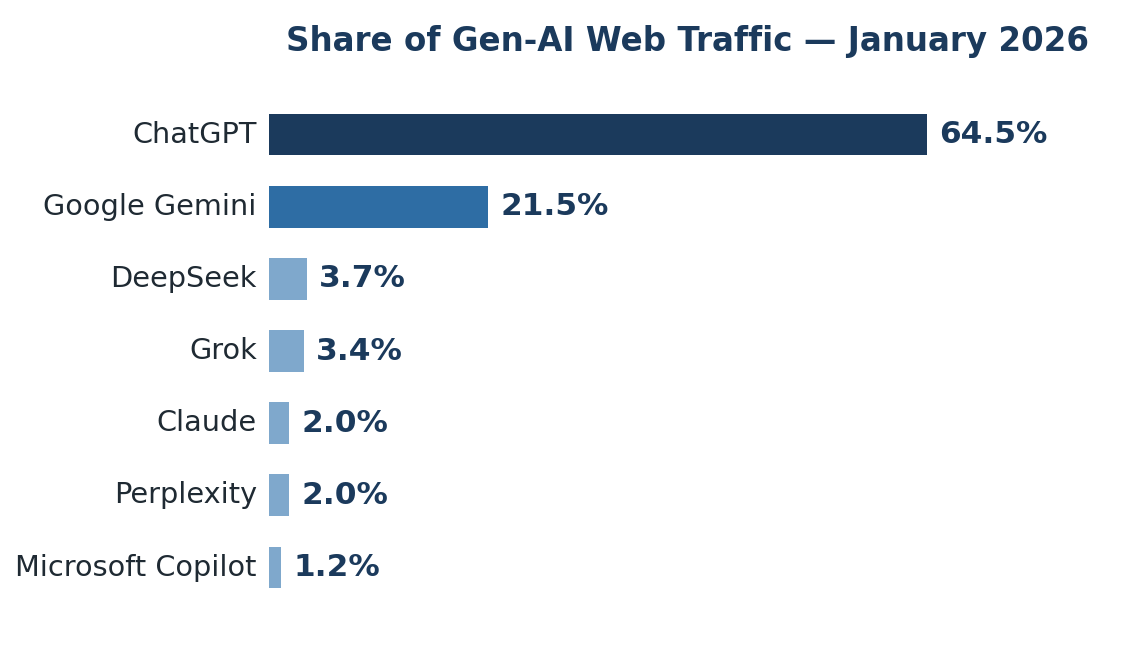
The shift to AI-driven research isn't a trend on the horizon. It's happening in your market right now. Here's what the numbers look like.
Section 1
How B2B Buyers Are Using AI Search
The research phase of B2B purchasing has always been invisible to vendors. Buyers don’t announce when they start looking. They read, compare, and form opinions long before they fill out a contact form.
AI search tools have made that research phase faster, more synthesized, and, crucially, more dependent on which vendors provide clear, credible, authoritative content online.
When a buyer asks an AI tool a research question, the tool isn’t just searching the web. It’s synthesizing answers from sources it considers authoritative, structured, and relevant. It generates a response with a confident tone, drawing on the content it has indexed and weighted.
The tools driving this shift are already mainstream:
- ChatGPT (with Browse and GPT-4): used for vendor comparisons, market research, and question-answering
- Perplexity AI: built specifically for web-sourced answers, used heavily for professional research tasks
- Google’s AI Overviews: appearing in standard search results above organic listings, seen by hundreds of millions of users
- Claude and others: growing in adoption among knowledge workers and business buyers
Across all of them, the behavior is similar: the buyer asks a research question, the AI synthesizes an answer, and the buyer uses that answer to shortlist or disqualify vendors.
For B2B tech companies, this means discovery now happens in places you can’t track with your current analytics. A buyer who found you in an AI-generated answer and then visited your site looks, in your data, like direct traffic. A buyer who was never mentioned looks like nothing.
Section 2
Why Most B2B Tech Companies Are Invisible in AI Search
If your company isn’t appearing when buyers ask AI tools about problems you solve, there are usually a handful of specific reasons, and most of them come down to how your content is written, not how much of it you have.
The content is optimized for clicks, not answers
Traditional SEO was largely about getting found in search results and earning a click. AEO is different: AI tools don’t serve up a list of results and let the user decide. They give an answer. Companies whose content has clear, confident answers to buyer questions get cited. Companies whose content is built around keyword density and page authority often don’t.
The copy describes the company instead of solving a problem
Most B2B tech websites are organized around what the company offers: product features, team credentials, and company history. This content doesn’t answer buyer questions. It asks buyers to care about information that only matters once they’ve already decided you’re worth talking to.
AI search engines surface content that answers questions buyers are asking: “How do I reduce customer churn in a SaaS product?” “What’s the difference between the X and the Y solution?” “What does it cost to implement Z?” If your content doesn’t engage with those questions, it doesn’t get cited.
The positioning is too broad to be authoritative
“We help businesses grow.” “Full-service digital solutions for companies of all sizes.” “End-to-end technology services.”
Copy like this signals nothing. AI systems, like human buyers, don’t treat broad positioning as evidence of expertise. Specific positioning, like “We help B2B SaaS companies reduce time-to-value for new users through onboarding copy and in-product messaging,” is what gets surfaced as an authoritative source for a specific problem.
The content isn’t structured for AI to use
Walls of paragraph text, product descriptions buried in PDFs, and service pages with no clear headings are difficult for AI systems to parse and summarize. Content structured with clear questions and answers, defined headings, and concise explanations of specific outcomes is far more likely to be pulled into an AI-generated response.
Section 3
What Answer Engine Optimization Is and Isn’t
AEO isn’t a replacement for SEO. It’s an expansion of the same underlying principle: make it easy for information systems to understand what you do, who you serve, and why you’re credible, so they surface you to the right buyers.
While SEO was built around keywords, metadata, and link authority, AEO is built around clarity, specificity, and authoritative answers to the questions your buyers ask.
AEO is the practice of structuring your content so that AI search systems can accurately represent your company when a buyer asks a question you should answer.
What that means:
- Your homepage needs to answer, clearly and specifically, what you do, who you do it for, and what changes for the buyer when they work with you.
- Your service or product pages need to explain outcomes, not just features.
- Your content (articles, FAQs, case studies) needs to engage with the questions real buyers are researching.
- Your brand positioning needs to be specific enough that an AI tool can place you accurately in a category and differentiate you from competitors.
It’s worth being clear about what AEO is not: it’s not about gaming AI systems with tricks, stuffing content with Q&A formats, or producing low-quality “optimized” pages at scale. AI systems are trained on quality signals. What works for AEO is the same thing that works for your buyers: content that is clear, specific, credible, and written for a real person trying to solve a real problem.
Section 4
The Five Signals That Get B2B Tech Companies Into the Answer
After reviewing how AI tools surface B2B vendors and the kinds of content they cite, five signals emerge consistently.
1. Specific, outcome-oriented positioning
AI tools cite companies whose positioning clearly defines who they serve and what results they produce. Vague categories don’t make the cut. Specific positioning like “enterprise data governance for regulated financial services companies” does.
2. Content that answers the buyer’s actual research questions
Buyers use AI tools to answer specific questions, not to find companies. The companies that get cited are the ones that have published clear, helpful content that answers those questions. If you want to appear when a buyer asks, “How do I improve B2B email open rates?” you need content that answers that question, not a service page that mentions email marketing.
3. Consistent authority signals across multiple surfaces
AI systems don’t just look at your website. They look at what’s been written about you, what you’ve published, and what others reference. Consistent presence across your website, LinkedIn, bylined articles, industry publications, and third-party review sites all contribute to how authoritatively an AI tool treats your company.
4. Structured, scannable content
Content that uses clear headings, short explanations, and direct answers is more likely to be pulled into an AI-generated response. Long-form content works well when it’s organized clearly. FAQs are particularly effective. Dense, unstructured text is harder for AI systems to parse and summarize accurately.
5. Copy that speaks the buyer’s language
The language of your content matters. AI systems are trained on what buyers search for and ask, which means industry jargon and internal terminology work against you. Content written in the language your buyers use to describe their problems will surface in answer to the questions they ask.
Section 5
Where to Start: The AEO Audit
Before you optimize anything, you need to know where you stand. What follows is an audit you can run yourself in about two hours, with no tools beyond a browser and an honest read of your own pages.
Work through it in order. Each step tells you something the next one depends on.
Step 1: Ask the AI tools what they say about you
Open ChatGPT, Perplexity, and Google's AI Overviews. Ask the questions your buyers would ask when they're in early research mode, before they know vendor names:
- “What are the best [your category] solutions for [your target market]?”
- “How do [your target companies] typically solve [the problem you solve]?”
- “What should I look for when choosing a [your product or service type] vendor?”
Run each question in at least two tools, and run each one twice. The answers vary, and the variation is information. For every run, write down four things: whether you appeared, where in the list, how you were described, and which sources the tool cited.
That last column is the one most teams skip, and it's the most useful. The cited sources are the shortlist you're competing to join. They're rarely vendor homepages. They're review sites, industry publications, comparison articles, and the occasional unusually clear service page. Note who's there.
There are three ways this goes, and each one means something different:
- You don't appear at all. That's a visibility gap, and it's almost always a content and positioning problem, not a technical one.
- You appear, but the description is generic — “a B2B software company,” “a marketing agency.” That's a positioning problem. The system found you and had nothing specific to say.
- You appear, but the description is wrong or out of date. That's a source problem. Something other than your own site is telling your story, and it's winning.
Step 2: Read your homepage the way a buyer reads it
Read the first three sentences of your homepage and ask one question: whose problem am I describing? If the answer is your company's capabilities rather than the buyer's situation, your content isn't structured to be quoted as an answer.
Then run two more checks.
The ten-second test. Hand the page to someone outside your industry and give them ten seconds. Can they tell you who it's for, what problem it solves, and what changes for the buyer? If they can't, an AI system reading the same page can't either.
The we-versus-you count. Read the page aloud and count how many sentences have “we” as the subject versus “you.” Most B2B homepages run four or five to one in favor of “we.” Each of those sentences gives an answer engine nothing about the buyer's situation to work with.
Step 3: Find the three questions buyers ask before they reach out
Not the questions you wish they asked. The ones they actually ask, in their words, before they're ready to talk. Four places to find them:
- Your last ten discovery calls. What came up in the first five minutes, every time?
- Your inbox. The questions people send before they book anything.
- Support tickets from a customer's first ninety days. These look like onboarding questions, but they're really the questions your site failed to answer before the sale.
- Google Search Console. Filter for queries phrased as questions. You may already be ranking for questions you never deliberately answered.
Now take your three and search your own site for each one. If the answer isn't there in plain language near the top of a page, it doesn't exist as far as an answer engine is concerned.
Step 4: Test your service and product pages against those questions
For each page, ask: if a buyer put this page's problem to an AI tool, would this page supply a credible answer? Or is it a description of what the service includes?
Three specific things to look for on every page:
- Does the page open with the buyer's problem, or with your service name? Opening with the service name tells the system what you sell but not what it's for.
- Is there a sentence that could be lifted whole and quoted as an answer? Answer engines quote. Give them something quotable — one clear, self-contained sentence that would still make sense to someone who never saw the rest of the page.
- Are outcomes stated in language a buyer would use, or in language only your team uses? Internal shorthand and product names are invisible to a system trained on how buyers actually ask.
Step 5: Check what's written about you everywhere else
Answer engines don't only read your website. They read your directory listings, your review profiles, your partner pages, the guest article you wrote two years ago, the podcast description, and your LinkedIn profile.
Pull up five or six of those and read the description of your company on each. Do they agree? Conflicting or stale descriptions give a system a reason to hedge — or to prefer someone else's account of what you do over your own.
This is where the sources you noted in Step 1 earn their keep. If a review site is getting cited and your service page isn't, the review site's description of you is currently your positioning, whether you wrote it or not.
Step 6: Decide what to fix first
You will finish this audit with a longer list than you can act on, which is why the last step is choosing. Don't start with what's most broken. Start with what's most valuable.
Ask which single question you most want to own — the one where being the cited answer would put you in front of the buyers you actually want. Then find the page that should answer it. For most B2B companies, that's the homepage plus one service page tied to the highest-value work.
Fix the page that answers your best question before you write anything new. New content is the more satisfying project and almost never the higher-return one.
What the audit tells you
Three outcomes, three different jobs:
- You appear, accurately, with your own pages among the cited sources. Your foundation is solid. This becomes maintenance — keeping the answers current as your market moves.
- You appear generically, or through someone else's description. You have a positioning problem. The system found you and couldn't tell anyone why you matter.
- You don't appear. The content that would get you cited hasn't been written yet.
All three are copy problems. None of them require rebuilding your website, changing platforms, or buying software. What they require is a clear-eyed look at whether your pages answer the questions your buyers are actually asking — and the willingness to rewrite the ones that don't.
Section 6
The Copy Problem at the Center of AEO
The single biggest factor in whether a B2B tech company gets surfaced by AI search is whether its copy answers questions buyers ask.
That sounds simple. But most B2B tech websites were written by people who know the product deeply, and that depth creates a blind spot. When you understand everything about what you offer, it’s natural to go with: What it is. What it does. How it works.
What buyers are asking and what AI tools are searching for are different: what does this solve? What does the buyer’s situation look like after they have it? Why choose your company over the alternatives?
The shift from feature-first copy to answer-first copy is at the core of AEO and of good B2B copy generally. These aren’t separate disciplines. The copy surfaced by AI tools is the same copy that human buyers read, understand, and act on.
Investing in your AEO copy isn’t a separate budget line from investing in your conversion copy. It’s the same investment, producing results in both places.
Which means the path to better AI visibility and the path to better website conversion are the same path. You don’t need two initiatives. You need one: copy that puts the buyer’s problem first, answers the right questions clearly, and positions your company as the specific, credible solution to a specific, real problem.
That’s what gets you in the answer. And that’s what gets the buyer to reach out.
Conclusion
Get Found Before the First Conversation
B2B buyers are already using AI tools to research and shortlist vendors. The companies that appear in those answers are building awareness and credibility before buyers ever visit their website.
Getting the answer isn’t complicated, but it requires an honest look at whether your current copy answers buyers' questions or was written for the company instead of the buyer.
Start with your homepage. Start with your three most important service or product pages. Ask whether a first-time reader, or an AI system, could extract a clear, specific answer to the question: “What does this company solve, for whom, and what changes when they work with it?”
If the answer is yes, your foundation for AEO is solid.
If the answer is no, that’s where the work starts. And it’s more straightforward than most teams expect.
Prefer the designed PDF?
Same paper, formatted for printing and forwarding — charts, cover, the lot. It takes an email address.
Get the PDF version →